If you've been exploring web development, chances are you've come across the term MERN stack. It's one of the most in-demand skill sets in the tech industry today, and for good reason — it lets developers build complete, production-ready web applications using a single language: JavaScript.
But what does a career actually look like once you learn MERN? In this post, we'll break down what the MERN stack is, why companies are hiring for it, the roles you can land, and how much you can expect to earn.
What is the MERN Stack?
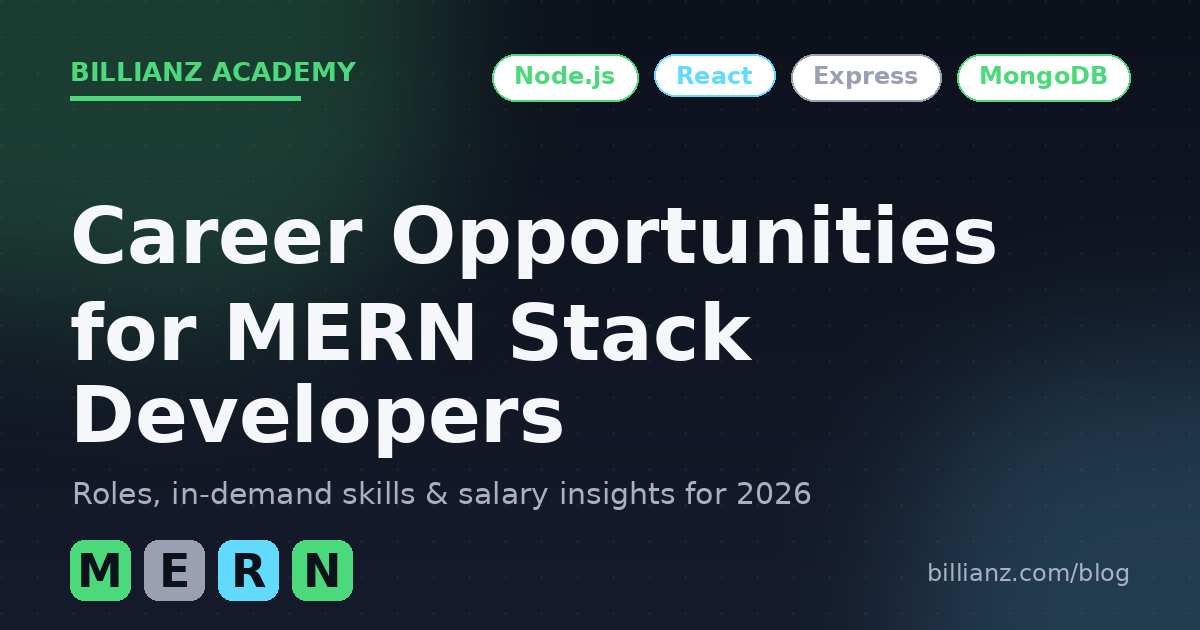
MERN is an acronym for four technologies that work together to build full-stack web applications:
- MongoDB – A NoSQL database that stores data in flexible, JSON-like documents.
- Express.js – A lightweight backend framework that runs on Node.js and handles routing, APIs, and server logic.
- React – A frontend library (maintained by Meta) used to build fast, interactive user interfaces.
- Node.js – A JavaScript runtime that lets you run JavaScript on the server, not just the browser.
The biggest advantage of MERN is that everything — frontend, backend, and database interactions — is written in JavaScript (or JSX). This means one developer can realistically build and maintain an entire application end to end, which is exactly why MERN developers are so valuable to startups and product teams.
Why Companies Are Hiring MERN Developers
A few reasons demand keeps growing:
- Faster development cycles — A single tech stack means less context-switching between languages and smaller, more efficient teams.
- Startup-friendly — Lean teams love MERN because it reduces the number of specialists needed to ship a product.
- Scalability — Node.js handles concurrent requests efficiently, and MongoDB scales horizontally, making the stack suitable for apps that need to grow fast.
- Massive ecosystem — npm has packages for nearly everything, which speeds up development significantly.
- React's dominance — React remains one of the most widely used frontend libraries, so React skills alone open doors even outside full MERN roles.
Career Roles You Can Pursue
Learning MERN doesn't lock you into one job title. Here are common roles this skill set qualifies you for:
1. Full-Stack Developer
The most direct fit — you handle both frontend (React) and backend (Node/Express/MongoDB) work, often for a single product or client.
2. Frontend Developer (React-focused)
If you enjoy UI/UX and building interfaces more than server logic, many roles focus purely on React, component architecture, and state management.
3. Backend Developer (Node.js-focused)
Some developers specialize in Express APIs, authentication systems, database design with MongoDB, and server architecture.
4. JavaScript Developer
A broader title used by companies that want flexible engineers comfortable across the entire JS ecosystem.
5. Software Engineer (Startup/Product companies)
Startups especially value MERN developers because they can move fast without needing a large, specialized team.
6. Freelance / Contract Developer
Because MERN lets one person build a complete product, it's one of the most freelance-friendly stacks — ideal for building client websites, MVPs, and small business apps.
Skills That Make You Stand Out
Knowing the four core technologies is the baseline. To be genuinely competitive, employers also look for:
- REST API design and increasingly, GraphQL
- Authentication & authorization (JWT, OAuth)
- Version control (Git/GitHub workflows)
- Deployment knowledge (Vercel, Netlify, Render, AWS, or a VPS)
- State management (Redux, Context API, or Zustand)
- Basic DevOps understanding — Docker, CI/CD basics
- Testing (Jest, React Testing Library)
Building 2–3 solid full-stack projects — deployed live, with clean GitHub repos and READMEs — matters far more to recruiters than certificates alone.
Salary Expectations (India Context)
While numbers vary by city, company size, and experience, general ranges for MERN developers in India look roughly like this:
- Freshers / 0–1 yrs: ₹3–6 LPA
- Mid-level / 2–4 yrs: ₹6–12 LPA
- Senior / 5+ yrs: ₹12–25+ LPA
Product-based companies and startups with funding tend to pay more than service-based companies for the same experience level, especially if you can demonstrate strong project ownership.
Is MERN Still Worth Learning?
Short answer: yes. Despite new frameworks emerging every year (Next.js, Remix, SvelteKit), the core skills inside MERN — JavaScript fundamentals, React, REST APIs, and database design — remain foundational across the industry. Even if you eventually move to a framework like Next.js, your MERN knowledge transfers almost entirely.
Final Thoughts
The MERN stack remains one of the most practical entry points into web development because it's approachable, well-documented, and backed by a massive community. Whether your goal is a full-time developer role, freelance work, or building your own product, mastering MERN gives you the flexibility to do all three with one skill set.
If you're starting out, focus less on tutorials and more on building — a task manager, a blog platform, an e-commerce mini-project. Deploy it, document it, and put it on GitHub. That's what actually gets you hired.