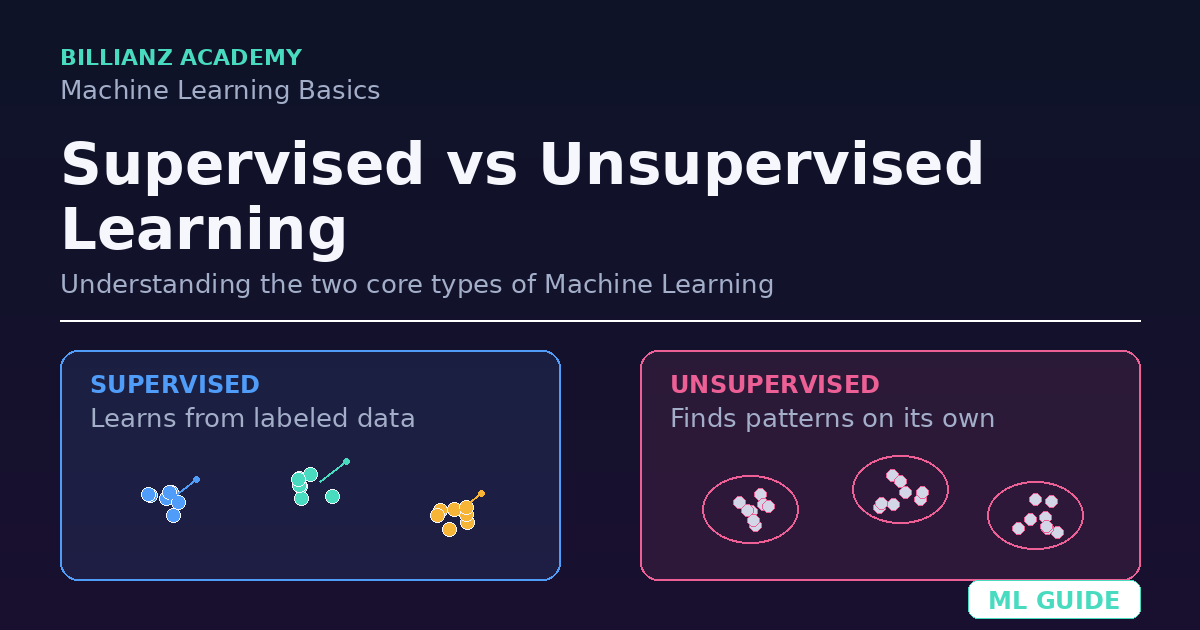
If you're starting your journey into Data Analytics, Machine Learning, or AI, one of the first concepts you'll run into is the difference between supervised learning and unsupervised learning. These are the two foundational approaches that power almost every machine learning model you'll encounter — from spam filters to product recommendation engines.
In this guide, we'll break down what each type of learning means, how they work, real-world examples, and when to use one over the other.
What is Supervised Learning?
Supervised learning is a type of machine learning where the model is trained on labeled data — meaning every training example comes with the correct answer (called the "label" or "target").
Think of it like a student learning with an answer key. The algorithm looks at input-output pairs, learns the relationship between them, and then uses that learned pattern to predict outputs for new, unseen data.
How It Works
- You feed the model input data (features) along with the correct output (label).
- The model learns a mapping function from inputs to outputs.
- Once trained, it predicts labels for new data it hasn't seen before.
Types of Supervised Learning
- Classification – Predicting a category or class (e.g., spam vs. not spam, disease vs. no disease).
- Regression – Predicting a continuous numerical value (e.g., house prices, sales forecasts).
Common Algorithms
- Linear Regression
- Logistic Regression
- Decision Trees
- Random Forest
- Support Vector Machines (SVM)
- Neural Networks
Real-World Examples
- Email spam detection – Classifying emails as spam or not spam based on labeled examples.
- House price prediction – Estimating property value using past sales data with known prices.
- Credit risk scoring – Predicting whether a loan applicant is likely to default.
- Medical diagnosis – Classifying X-rays or scans as showing a disease or not, based on labeled medical images.
What is Unsupervised Learning?
Unsupervised learning works with unlabeled data — there's no answer key. The algorithm's job is to explore the data on its own and find hidden patterns, structures, or groupings without being told what to look for.
It's like giving someone a pile of mixed objects and asking them to sort it into groups based on similarities, without telling them what categories exist.
How It Works
- You feed the model data with no predefined labels.
- The algorithm analyzes the structure and relationships within the data.
- It groups, compresses, or organizes the data based on similarity or patterns it discovers.
Types of Unsupervised Learning
- Clustering – Grouping similar data points together (e.g., customer segments).
- Association – Finding relationships between variables (e.g., items frequently bought together).
- Dimensionality Reduction – Simplifying data by reducing the number of variables while preserving key information.
Common Algorithms
- K-Means Clustering
- Hierarchical Clustering
- DBSCAN
- Principal Component Analysis (PCA)
- Apriori Algorithm
Real-World Examples
- Customer segmentation – Grouping customers by purchasing behavior for targeted marketing.
- Market basket analysis – Discovering that customers who buy bread often also buy butter.
- Anomaly detection – Identifying unusual transactions that may indicate fraud.
- Recommendation systems – Grouping similar users or products to suggest new content.
Supervised vs Unsupervised Learning: Key Differences
| Aspect | Supervised Learning | Unsupervised Learning |
| Data used | Labeled data | Unlabeled data |
| Goal | Predict known outcomes | Discover hidden patterns |
| Human involvement | High (labels must be provided) | Low (model explores on its own) |
| Common tasks | Classification, Regression | Clustering, Association, Dimensionality Reduction |
| Output | Specific prediction (category/value) | Groupings or structure |
| Examples | Spam detection, price prediction | Customer segmentation, anomaly detection |
| Complexity of setup | Requires labeled dataset (time-intensive) | Works with raw data (faster to start) |
| Accuracy evaluation | Easy to measure (compare predictions to actual labels) | Harder to measure (no ground truth) |
Which One Should You Learn First?
If you're new to data analytics or machine learning, supervised learning is usually the better starting point. It's more intuitive because you can directly measure how accurate your model is by comparing predictions to known correct answers. Concepts like regression and classification also form the backbone of most beginner and intermediate ML curricula.
Once you're comfortable with supervised techniques, moving into unsupervised learning helps you tackle real-world problems where labeled data isn't available — which is extremely common in business settings like customer analytics and fraud detection.
Conclusion
Supervised and unsupervised learning represent two different philosophies of teaching a machine to learn. Supervised learning relies on labeled data and clear feedback, making it ideal for prediction tasks. Unsupervised learning thrives on raw, unlabeled data, uncovering patterns humans might miss entirely.
Understanding both is essential for anyone building a career in data analytics or machine learning — they're not competing approaches, but complementary tools that are often used together in real-world data science workflows.