If you're starting out in the data field, you've probably run into this question more than once: should I become a data analyst or a data scientist?
The two titles get thrown around so often that people assume they're interchangeable. They're not. They involve different skills, different tools, and different day-to-day work — even though both roles deal with the same raw material: data.
This guide breaks down the real differences so you can figure out which path actually fits you.
The Short Answer
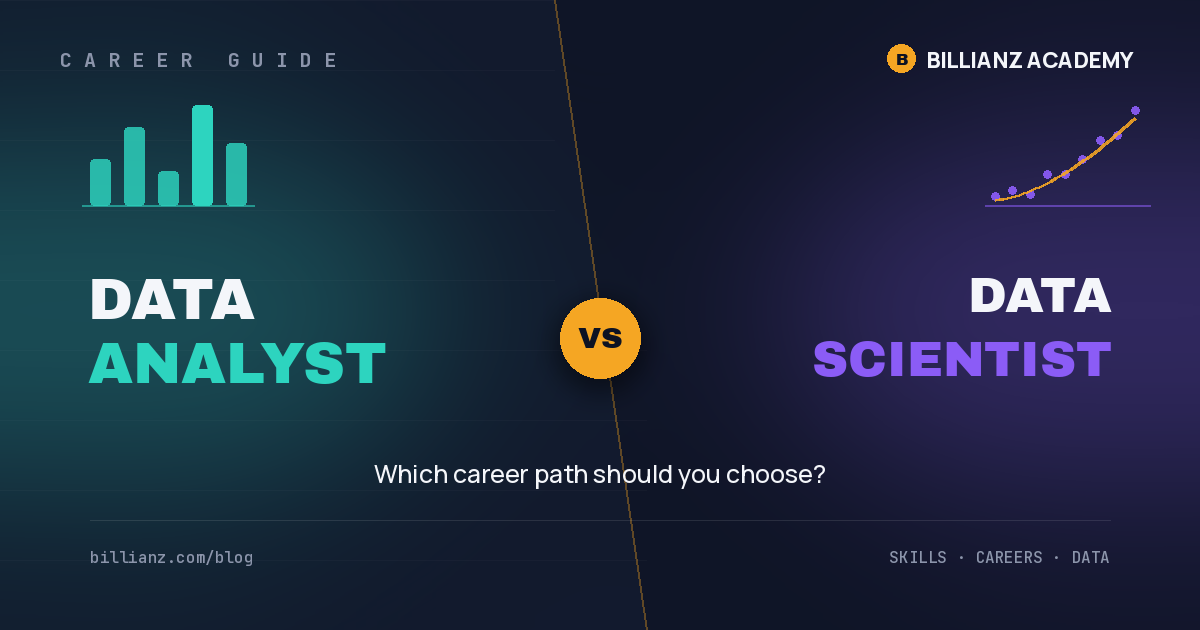
A data analyst looks at data that already exists and explains what it means — trends, patterns, and insights that help a business make decisions today.
A data scientist builds systems that predict what will happen next — using statistics, machine learning, and programming to solve problems that don't have an obvious answer yet.
Think of it this way: a data analyst tells you what happened and why. A data scientist tells you what's likely to happen next, and builds something to act on it automatically.
What Each Role Actually Does Day to Day
A data analyst typically:
- Pulls data from spreadsheets, databases, or dashboards
- Cleans and organizes messy data
- Builds reports and dashboards (Excel, Power BI, Tableau)
- Writes SQL queries to answer business questions
- Presents findings to managers or stakeholders
A data scientist typically:
- Builds machine learning models to predict outcomes
- Writes production-level Python or R code
- Works with large, unstructured datasets
- Designs experiments (A/B testing, statistical modeling)
- Collaborates with engineers to deploy models into products
Skills and Tools Compared
| Area | Data Analyst | Data Scientist |
| Core tools | Excel, SQL, Power BI/Tableau | Python, R, SQL, ML libraries (scikit-learn, TensorFlow) |
| Math background | Basic statistics | Statistics, linear algebra, probability |
| Programming | Light to moderate | Strong, often daily |
| Output | Reports, dashboards, insights | Models, algorithms, predictions |
| Typical background | Business, commerce, any degree + upskilling | Computer science, statistics, engineering, or strong self-taught foundation |
Career Path and Entry Point
Here's something most beginners don't realize: data analyst is usually the easier entry point, even if your long-term goal is data science.
Why? Because the analyst role builds the exact foundation you'll need later — comfort with real, messy data, SQL fluency, and the habit of asking "does this number actually make sense?" Many data scientists started as analysts before moving into machine learning.
If you're a complete beginner, a rough learning order looks like this:
- Excel — get comfortable with formulas, pivot tables, and basic data cleaning
- SQL — learn to pull and filter data from databases
- Data visualization — Power BI or Tableau to tell stories with data
- Python for analysis — pandas, NumPy, basic statistics
- Machine learning — only once the above feels solid
Trying to jump straight to machine learning without this foundation is one of the most common reasons beginners get stuck or overwhelmed.
Salary Expectations (India)
As a rough guide for the Indian market in 2026:
- Data Analyst (fresher to 2 yrs): ₹4–8 LPA
- Data Analyst (2–5 yrs): ₹8–15 LPA
- Data Scientist (fresher to 2 yrs): ₹6–12 LPA
- Data Scientist (2–5 yrs): ₹15–30 LPA
Data scientist roles generally pay more, but they also expect a stronger technical and mathematical background — and often 1–2 years of relevant project or analyst experience before companies hire for senior data science roles.
Which One Should You Choose?
Ask yourself these questions:
- Do you enjoy working with numbers, spreadsheets, and telling clear stories from data? → Start with data analyst.
- Do you enjoy coding, math, and building things that predict outcomes? → Aim for data scientist, but expect a longer runway.
- Not sure yet? → Start with data analyst skills anyway. They're faster to learn, more in-demand for freshers, and every data scientist needs them regardless.
The Bottom Line
You don't have to pick one forever. Most people move from analyst to scientist as their skills grow — not the other way around. The smartest move for a beginner isn't picking the "cooler" title; it's picking the path that gets you hired first and builds the right foundation for wherever you want to go next.
Start with the fundamentals — Excel, SQL, and visualization — and let your interests guide you from there.