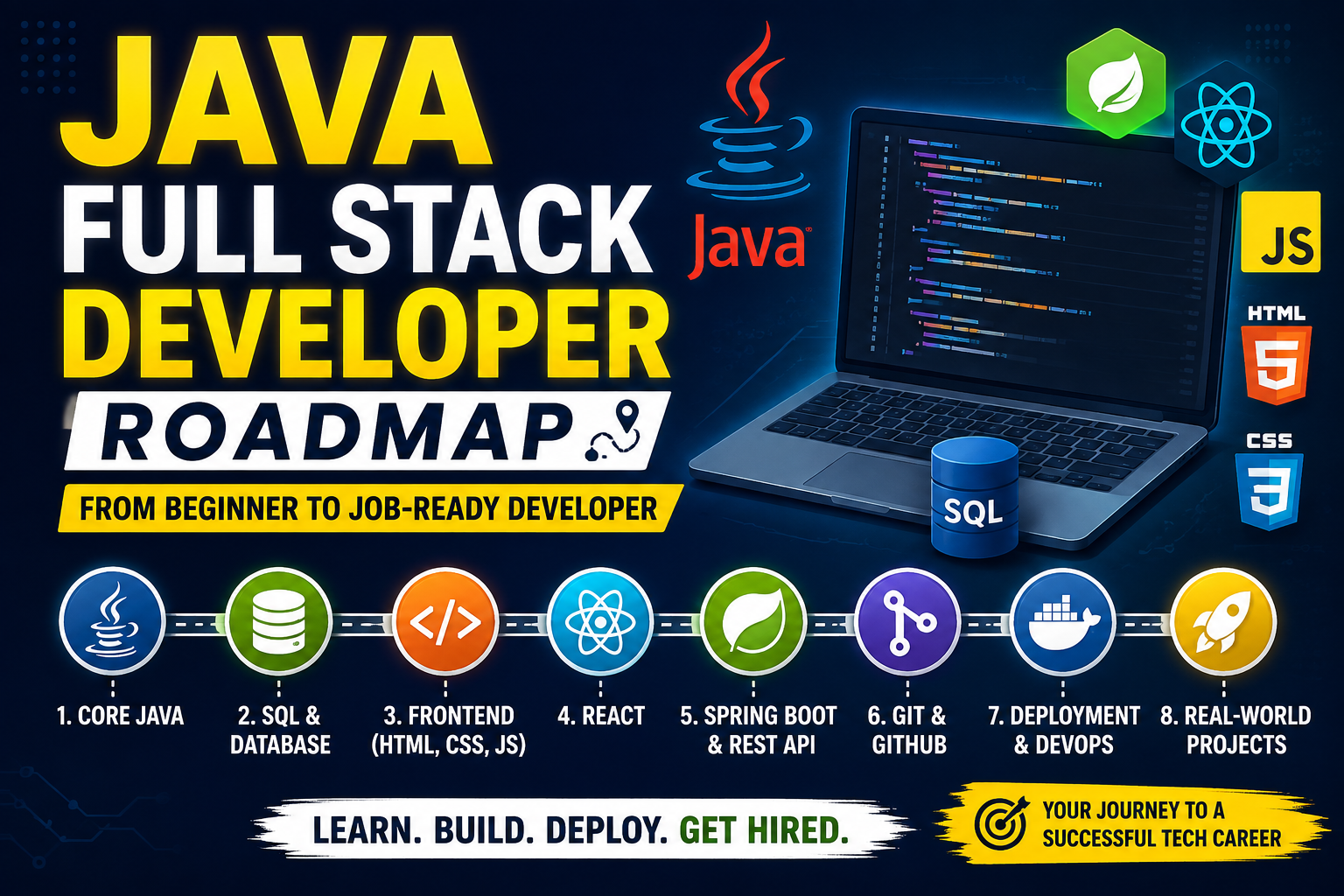
Becoming a Java Full Stack Developer is a great career choice if you want to build both the frontend and backend of modern web applications. A full-stack developer works on everything from designing the user interface to developing APIs, managing databases, and deploying applications.
If you're starting from scratch, the number of technologies can feel overwhelming. This roadmap breaks the journey into clear stages, so you know what to learn, in what order, and why it matters.
1. Start with Core Java
The first step is to build a strong foundation in Java. Don't rush into frameworks before understanding the language properly.
Focus on:
- Variables and data types
- Operators
- Conditional statements
- Loops
- Arrays and Strings
- Methods and functions
- Object-Oriented Programming (OOP)
- Exception handling
- Collections Framework
- Generics
- File handling
- Multithreading
- Java 8+ features such as Lambda Expressions and Streams
OOP is especially important because most Java applications are designed around classes and objects.
2. Learn Database Management and SQL
Almost every real-world application needs a database. After learning Java fundamentals, start working with SQL and relational databases.
Learn:
- Tables and relationships
- Primary and foreign keys
- CRUD operations
- SELECT queries
- Joins
- Subqueries
- Aggregate functions
- GROUP BY and HAVING
- Indexes
- Normalization
- Transactions
You can start with databases such as MySQL or PostgreSQL.
3. Learn Frontend Development
A full-stack developer must also understand how the frontend communicates with the backend.
Start with:
HTML
Learn how to structure web pages using elements, forms, tables, semantic HTML, and accessibility practices.
CSS
Learn:
- Selectors
- Box model
- Flexbox
- Grid
- Responsive design
- Animations
JavaScript
JavaScript connects the user interface with backend services. Focus on:
- Variables and data types
- Functions
- Arrays and objects
- DOM manipulation
- Events
- ES6+ features
- Promises
- Async/Await
- Fetch API
- JSON
4. Learn a Frontend Framework
Once you are comfortable with JavaScript, move to a modern frontend framework. React is a popular choice for Java developers.
Learn concepts such as:
- Components
- Props
- State
- Hooks
- Forms
- Routing
- API integration
- State management
- Reusable components
Your goal isn't just to create attractive pages. You should be able to build a frontend that consumes data from your Java backend.
5. Master Spring and Spring Boot
This is the heart of modern Java backend development.
Start with Spring Framework, then move into Spring Boot, which simplifies the process of creating production-ready applications.
Important topics include:
- Dependency Injection
- Inversion of Control
- Spring MVC
- REST APIs
- Controllers
- Services
- Repositories
- Configuration
- Validation
- Exception handling
- Spring Data JPA
- Hibernate
- Authentication and authorization
You should eventually be comfortable building REST APIs that connect your frontend application to a database.
6. Learn Git and GitHub
Version control is an essential developer skill.
Learn how to:
- Create repositories
- Commit changes
- Create branches
- Merge branches
- Resolve conflicts
- Push and pull code
- Work with pull requests
Create a GitHub profile and use it to showcase your projects.
7. Understand Testing
Writing code is only part of development. You also need to make sure your application works correctly.
Learn the basics of:
- Unit testing
- Integration testing
- JUnit
- Mockito
- API testing
Tools such as Postman can also help you test and debug REST APIs.
8. Learn Deployment and DevOps Basics
A job-ready developer should know how an application goes from their computer to a production environment.
Learn the basics of:
- Linux
- HTTP/HTTPS
- Servers
- Environment variables
- Docker
- CI/CD
- Cloud deployment
- Basic AWS or Azure concepts
You don't need to become a DevOps engineer, but understanding deployment will make you a much stronger full-stack developer.
9. Build Real-World Projects
Projects are where everything comes together.
Instead of building only small tutorials, create applications that demonstrate complete development skills.
Some project ideas:
Beginner:
- To-Do Application
- Student Management System
- Expense Tracker
Intermediate:
- E-commerce Application
- Job Portal
- Online Learning Platform
- Inventory Management System
Advanced:
- Banking Application
- Food Delivery Platform
- Project Management System
- Full-stack SaaS Application
For every major project, try to include a React frontend + Spring Boot backend + SQL database + REST APIs + authentication + GitHub + deployment.
10. Prepare for Job Interviews
Once you've built a few solid projects, start preparing for interviews.
Focus on:
- Core Java
- OOP
- Collections
- Exception handling
- Java 8+
- SQL
- Spring Boot
- REST APIs
- Hibernate/JPA
- JavaScript
- React
- Git
- Basic system design
- Data structures and algorithms
Also prepare to explain your projects clearly. Interviewers often want to know why you chose a particular technology, how your application works, and what problems you solved.
Final Roadmap
A simple learning sequence looks like this:
Core Java → SQL → HTML/CSS → JavaScript → React → Spring → Spring Boot → Hibernate/JPA → REST APIs → Git/GitHub → Testing → Docker → Cloud → Projects → Interview Preparation
The key is consistency. You don't need to learn every technology at once. Build your knowledge step by step, practice by writing code, and continuously turn what you learn into projects.
With a strong foundation in Java, modern frontend skills, Spring Boot, databases, and real-world project experience, you can move from beginner to a job-ready Java Full Stack Developer.