If you're starting out in web development, you've probably run into two very different worlds of advice. One camp tells you to learn HTML, CSS, PHP, and MySQL — the "traditional" way websites have been built for decades. The other camp swears by the MERN stack — MongoDB, Express.js, React, and Node.js — as the modern, job-ready path.
So which one actually deserves your time? Let's break both down.
What Is Traditional Web Development?
Traditional web development usually refers to the multi-page, server-rendered approach that powered the web for most of its history. A typical traditional stack looks something like:
- Frontend: HTML, CSS, and a sprinkle of JavaScript
- Backend: PHP, ASP.NET, or Java (Servlets/JSP)
- Database: MySQL, PostgreSQL, or SQL Server
- Rendering: The server builds the full HTML page and sends it to the browser on every request
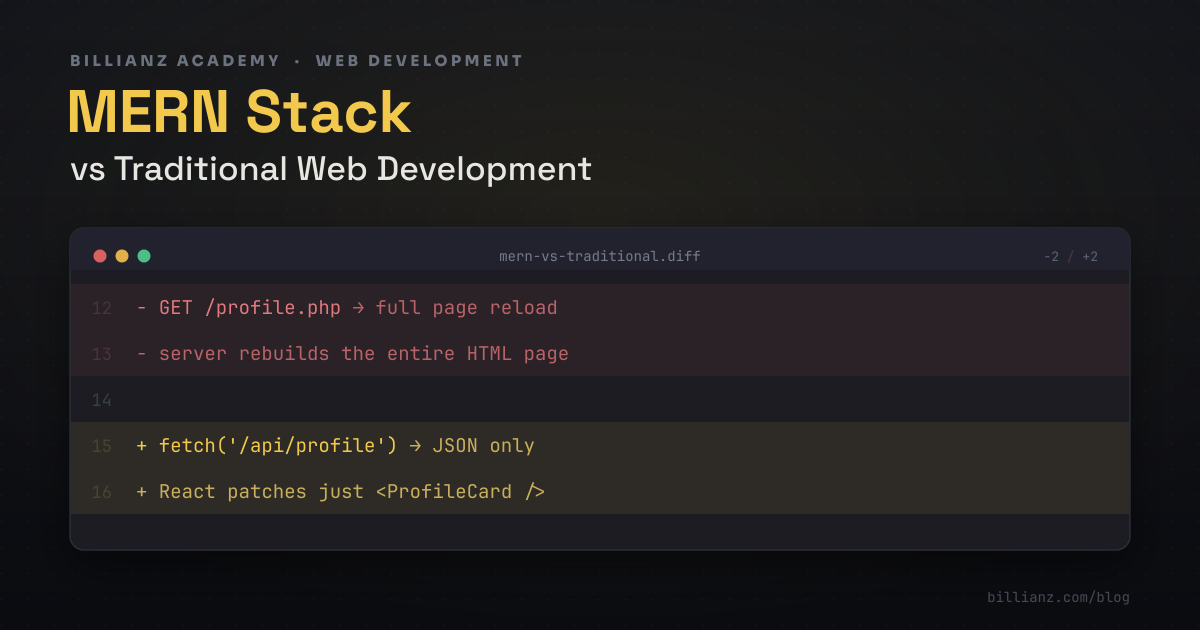
Think of classic WordPress sites, old-school PHP forums, or enterprise Java applications. Every time you click a link, the browser sends a request, the server processes it, queries the database, builds a new HTML page, and sends the whole thing back. The page reloads.
This approach is battle-tested, well-documented, and still runs a massive chunk of the internet — including most CMS platforms and a large share of enterprise software.
What Is the MERN Stack?
MERN is a JavaScript-only stack made up of four technologies:
- MongoDB – a NoSQL database that stores data as flexible, JSON-like documents
- Express.js – a lightweight backend framework that runs on Node.js
- React – a frontend library for building interactive user interfaces
- Node.js – a JavaScript runtime that lets you run JS on the server, not just the browser
The defining feature of MERN isn't just the four tools — it's the architecture it enables: Single Page Applications (SPAs). Instead of reloading the whole page, React updates only the parts of the UI that change, while talking to the backend through APIs (usually REST or GraphQL). The result feels faster and more app-like — think Gmail, Facebook, or Trello.
Head-to-Head Comparison
| Factor | Traditional Web Dev | MERN Stack |
| Language(s) | Often multiple (PHP/Java + JS + SQL) | JavaScript end-to-end |
| Architecture | Multi-page, server-rendered | Single Page Application (SPA) |
| Database | Relational (SQL) | Non-relational (MongoDB, NoSQL) |
| User Experience | Full page reloads | Smooth, app-like transitions |
| SEO | Generally easier out of the box | Needs extra setup (SSR, meta tags) |
| Learning Curve | Gentler to start, but multiple languages | Steeper upfront, but one language throughout |
| Scalability | Proven for large, structured systems | Great for real-time, API-driven apps |
| Job Market Fit | Common in enterprise/legacy systems | Common in startups and modern product teams |
Where Each One Wins
Traditional web development is a strong choice when:
- You're building a content-heavy site where SEO really matters (blogs, news sites, e-commerce catalogs)
- Your data is highly structured and relational — think banking, inventory, or HR systems
- You're maintaining or extending an existing legacy system (a huge number of real jobs involve this)
- You want strong built-in data integrity through SQL constraints and relationships
MERN shines when:
- You're building interactive, real-time apps — dashboards, chat apps, social platforms
- You want one language (JavaScript) across the entire stack, which speeds up development and hiring
- Your data doesn't fit neatly into rows and columns and benefits from MongoDB's flexible schema
- You're a startup that needs to ship features fast and iterate often
The Trade-Offs Nobody Mentions
MERN's flexibility can also be a trap for beginners. Because MongoDB doesn't enforce a strict schema the way SQL does, it's easy to end up with messy, inconsistent data if you're not disciplined. SEO for SPAs also needs extra work — search engines historically struggled with JavaScript-rendered content, though tools like Next.js (server-side rendering for React) have closed that gap significantly.
On the traditional side, the biggest pain point is usually development speed. Full page reloads and juggling two or three languages (say, PHP on the backend and vanilla JS on the frontend) can slow teams down compared to a unified JavaScript workflow.
So, Which Should You Learn First?
Here's the honest answer: it depends on your goal, not on which is "better."
- If you want to work in enterprise IT, government systems, or maintain existing large-scale software — traditional stacks (especially SQL and a backend language like Java or PHP) are still extremely relevant and often required.
- If your goal is to build modern web apps, join a startup, or freelance building client-facing products quickly — MERN gives you a faster, more cohesive path, and JavaScript skills transfer well across frontend and backend roles.
Many working developers actually end up learning both over time. Understanding relational databases and server-rendered pages gives you a much deeper appreciation of why SPAs and NoSQL databases were built the way they are — and vice versa.
Final Thoughts
There's no universal winner here. Traditional web development gives you strong fundamentals in how the web actually works — requests, responses, and structured data. MERN gives you speed, a unified language, and the architecture behind most modern web apps you use daily.
If you're just starting out, pick one path, build two or three real projects with it, and only then explore the other. Depth beats breadth when you're learning — you can always add the second stack to your toolkit later.