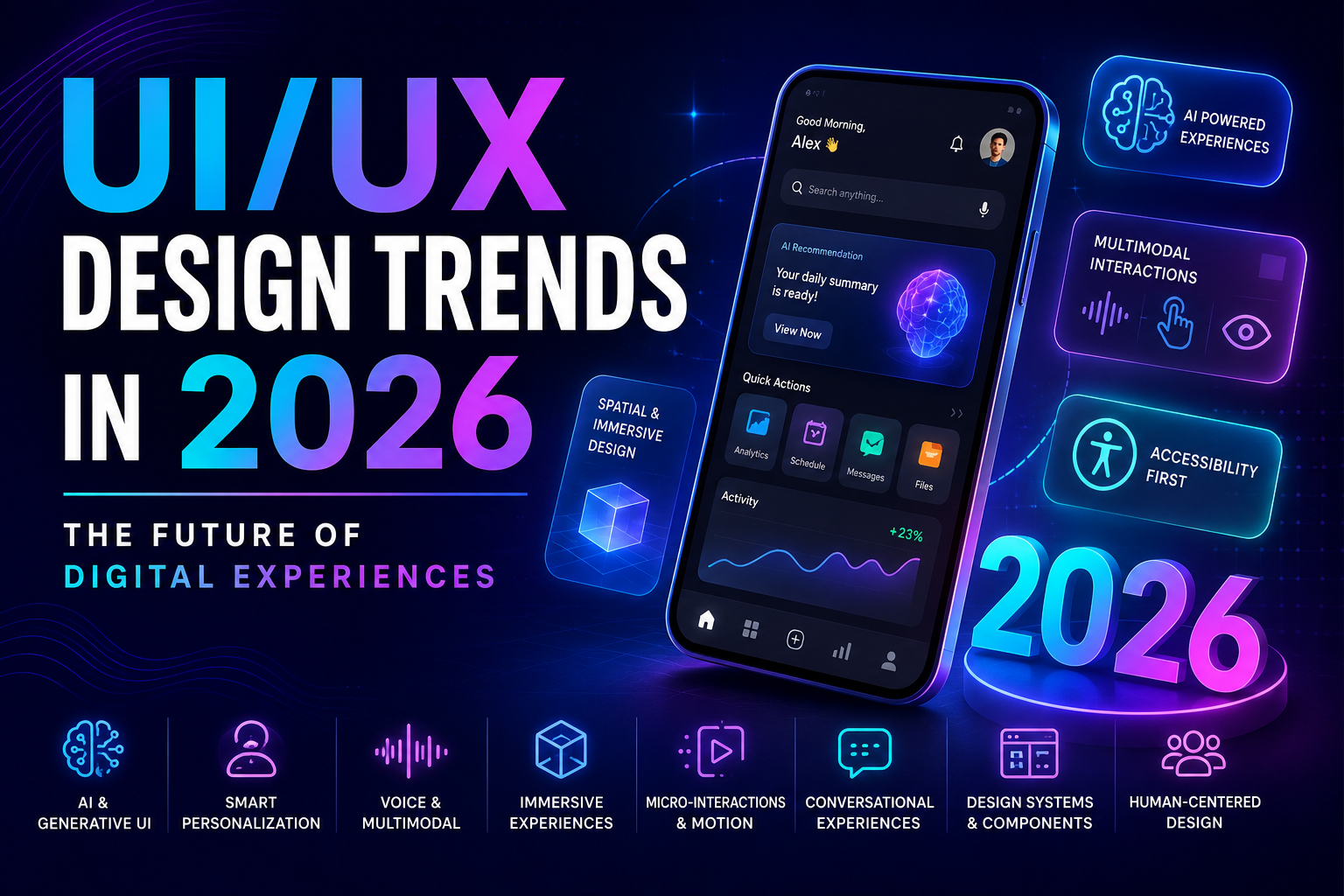
UI/UX design is evolving rapidly in 2026. Artificial intelligence, personalization, accessibility, immersive interfaces, and new interaction methods are changing the way users experience websites and applications. The focus is no longer simply on making interfaces visually attractive—it is about creating experiences that are intelligent, intuitive, inclusive, and genuinely useful.
According to Figma’s 2026 research, AI is increasingly becoming part of everyday design workflows, while designers are placing greater emphasis on judgment, collaboration, and the quality of the final experience.
1. AI-Powered and Generative UI
One of the biggest UI/UX trends in 2026 is the integration of AI into the interface itself.
Instead of presenting every user with exactly the same layout, AI-powered interfaces can adapt content, recommendations, navigation, and actions based on a user's needs and context.
For example, an e-commerce application could automatically prioritize products based on a customer's browsing behavior, while a productivity application could surface the tools a user is most likely to need.
Generative UI takes this further by allowing parts of an interface to be created dynamically depending on the user's request or task.
The result is a shift from static interfaces to adaptive experiences.
2. Personalization Becomes More Intelligent
Personalization is moving beyond simply displaying a user's name or recommending products.
In 2026, digital products are increasingly designed to understand user behavior and provide relevant experiences at the right moment. Personalized dashboards, adaptive navigation, customized recommendations, and context-aware content can reduce unnecessary steps and make applications easier to use.
However, designers also need to balance personalization with privacy and transparency. Users should understand how their data is being used and have meaningful control over their experience.
3. Multimodal Interfaces
Users are no longer limited to clicking, tapping, and typing.
Voice, gestures, images, touch, and conversational interactions are becoming increasingly important parts of digital experiences. Figma's 2026 web-design guidance highlights voice interfaces as an emerging way to support navigation, assistance, and hands-free interaction.
For example, instead of searching through multiple menus, users may simply ask an application to perform an action.
This creates an important challenge for designers: experiences must remain understandable regardless of how users interact with them.
4. Accessibility-First Design
Accessibility is becoming a fundamental part of UI/UX rather than something added just before launch.
Designers are paying more attention to color contrast, typography, keyboard navigation, screen readers, focus states, captions, alternative text, and understandable interaction patterns.
Modern design tools are also making accessibility checks easier to perform during the design process. Figma, for example, has introduced tools that can identify contrast problems and suggest accessible color combinations.
The goal is simple: design products that can be comfortably used by as many people as possible.
5. Spatial and Immersive Design
Spatial design is bringing more depth into digital interfaces.
Three-dimensional elements, layered interfaces, immersive environments, AR, and VR can create experiences that feel more natural and engaging. However, spatial effects should serve a purpose rather than simply being decorative.
Depth can be used to establish hierarchy, guide attention, communicate relationships between objects, or make interactions easier to understand.
The future of UI isn't necessarily about adding more 3D elements—it is about using spatial design when it improves the experience.
6. Micro-Interactions and Functional Motion
Animations and micro-interactions are becoming more purposeful.
A button changing state, a card expanding, a progress indicator moving, or a confirmation animation can communicate what is happening without requiring additional text.
In 2026, motion is increasingly treated as part of interaction design rather than decoration. Figma describes functional motion as a way to connect interface states, communicate changes, and even help users understand transitions during loading.
Good motion should feel natural and helpful. Too much animation can distract users and make an interface frustrating.
7. Conversational and Agentic Experiences
AI assistants are evolving from simple chatbots into systems capable of completing multi-step tasks.
Instead of merely answering a question, an AI agent might help users research a product, compare options, complete a form, or perform actions inside an application.
This changes the role of UX designers. Designers now need to think about not only screens and buttons, but also conversations, AI decisions, errors, confirmations, permissions, and user control.
As AI becomes more capable, transparent and predictable interactions will become increasingly important.
8. Design Systems and Component-Based Experiences
Large digital products need consistency across websites, mobile applications, dashboards, and other platforms.
Design systems help teams create reusable components, maintain visual consistency, and speed up development. In 2026, the relationship between design and development is becoming even closer as designers work with reusable components and more code-aware workflows.
Figma's 2026 research also indicates that designers and developers are increasingly participating in each other's work, reducing the traditional gap between design and development.
9. Calm and Content-Focused Interfaces
Minimalism is evolving.
Instead of simply removing visual elements, modern interfaces are focusing on reducing cognitive load. Clear typography, strong hierarchy, whitespace, meaningful visuals, and focused navigation help users understand what matters.
The goal is not to create an empty interface. It is to create an interface where every element has a purpose.
10. Human-Centered Design in the Age of AI
Perhaps the most important trend of 2026 is that technology is becoming more powerful while human-centered design is becoming more important.
AI can generate layouts, code, images, prototypes, and content quickly. But it cannot completely replace human judgment about whether a product actually solves the right problem.
Figma's 2026 research found that 90% of respondents believe design is at least as important as it was before AI, with nearly six in ten saying it is more important.
This means designers need to focus increasingly on research, empathy, usability, accessibility, storytelling, product thinking, and decision-making.
The Future of UI/UX Design
The future of UI/UX is not about following every visual trend. It is about understanding why a trend exists and whether it creates value for users.
AI will make interfaces smarter. Personalization will make experiences more relevant. Multimodal interactions will provide new ways to interact with products. Accessibility will make digital experiences more inclusive, while spatial design and functional motion will create richer interactions.
The designers who succeed in this changing environment will be those who combine technology with human understanding.
In 2026, great UI/UX design is not simply about making digital products look better—it is about making them smarter, simpler, more accessible, and more human.
Conclusion
UI/UX design is entering an exciting new phase. As AI and emerging technologies reshape digital products, designers have more tools than ever to experiment, prototype, and create.
But technology alone does not guarantee a great user experience. The strongest products will combine intelligent technology with clear design, accessibility, privacy, usability, and human-centered thinking.
The future of digital experiences belongs to designers who can use new technology while never losing sight of the person using the product.