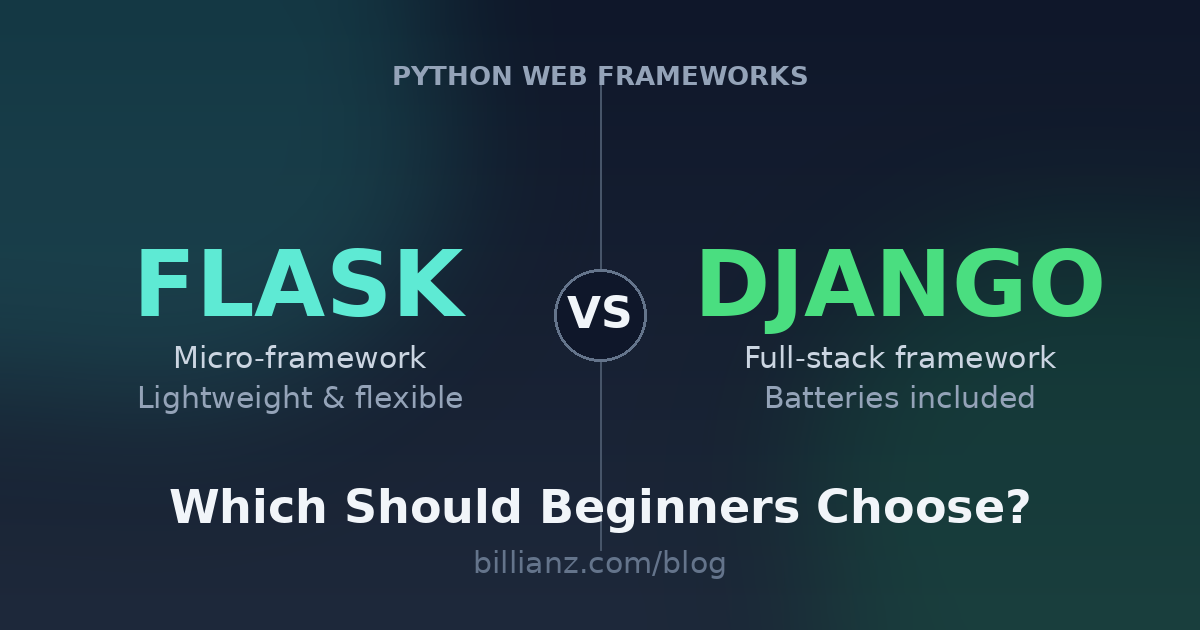
"New to Python web development? Flask and Django are the two frameworks you'll keep hearing about — but they solve different problems. This quick guide breaks down the core differences, when to use each, and which one to learn first if you're just starting out."
The Core Difference
Flask is a micro-framework. It gives you the essentials (routing, requests, templates) and lets you add everything else yourself — database, authentication, admin panel, all optional plugins.
Django is a full-stack, "batteries-included" framework. It ships with an ORM, admin dashboard, authentication system, and more, all built to work together out of the box.
Think of Flask as a build-your-own-bike kit, and Django as a bike that arrives fully assembled.
Quick Comparison
| Factor | Flask | Django |
| Learning curve | Gentle — few concepts to start | Steeper — more built-in structure to learn |
| Setup time | Fast for small apps | Slower start, faster for big apps |
| Flexibility | High — pick your own tools | Opinionated — Django's way is the way |
| Built-in admin panel | No | Yes |
| Built-in ORM | No (use SQLAlchemy separately) | Yes |
| Best for | APIs, small apps, learning fundamentals | Large apps, content-heavy sites, teams |
When Flask Makes Sense
- You're learning how web frameworks actually work under the hood
- You're building a small API or microservice
- You want full control over your project structure
- You're prototyping something quickly
When Django Makes Sense
- You're building something with users, an admin backend, and a database from day one
- You want a lot of functionality without hunting for third-party packages
- You're working with a team and need consistent project structure
- You're building a content-driven site (blog, e-commerce, dashboard)
Code Feel: A Tiny Taste
Flask — minimal and explicit:
Django — more structure, more conventions:
Both look simple here — the real difference shows up as your app grows.
So, Which One Should You Learn First?
If you're brand new to web development, start with Flask. You'll understand what a framework is actually doing for you, instead of relying on Django's magic. Once you're comfortable, learning Django will feel like leveling up rather than starting over.
If you already know you're building something bigger — a real product with users, an admin panel, and a database — jump straight to Django and save yourself the rebuild later.
The Bottom Line
There's no wrong choice here. Flask teaches you the fundamentals; Django teaches you how to scale. Many developers end up learning both — Flask for small tools and APIs, Django for full applications. Pick based on what you're building today, not what you might build someday.